

Skip to main navigation menu Skip to main content Skip to site footer

No. 1(16) (2022)

Blok tematyczny: Niektóre problemy nowego porządku międzynarodowego

The immigration as a factor of the status change of Poland in the globalised world

Published: 2022-06-30

Abstract

The paper analyzes the migration processes that have taken place and are still taking place in Poland as a factor that can positively influence the perception of Poland in the world. Poland is an example of a country that very quickly changed its status from an emigration state to an immigration one. This is evidenced by the positive migration balance and the issuance of the largest number of temporary residence permits in the European Union. The status of an immigration state was confirmed by the influx of war refugees from Ukraine and numerous decisions to stay in Poland for a long time and permanently, as well as an attempt to open a new migration pathway running through the Polish-Belarusian border. It should be assumed that with appropriate conduct of foreign policy, this new situation in Poland can strengthen its international position and perception. At the same time, there are also risks associated with it. If there is a failure to respond properly and in accordance with the law and the rules of democratic states to the migration challenges, it could result in the entrenchment of negative opinions about Poland from the migration perspective that emerged during the migration crisis of 2015–2016.

References

  1. Bukowski Maciej, Duszczyk Maciej (red.) (2022), Gościnna Polska 2022+, Warszawa: Wise Europa. [Google Scholar]
  2. Bundespolizei (2022), Illegale Migration aus Belarus über Polen nach Deutschland konstant auf niedrigem Niveau: 361 Feststellungen durch die Bundespolizei seit Jahresbeginn, https://www.bundespolizei.de/Web/DE/04Aktuelles/01Meldungen/2021/10/staendige_aktualisierung_migrationslage.html (dostęp 10.05.2022). [Google Scholar]
  3. Dane statystyczne dot. wniosków o nadanie statusu UKR w związku z konfliktem w Ukrainie (2022), https://dane.gov.pl/pl/dataset/2715,zarejestrowane-wnioski-o-nadanie-statusu-ukr/resource/37912/table?page=2&per_page=20&q=&sort= (dostęp 5.05.2022). [Google Scholar]
  4. Duszczyk Maciej (2012), Polska polityka imigracyjna a rynek pracy, Warszawa: Oficyna Wydawnicza Aspra J.R. [Google Scholar]
  5. Duszczyk Maciej, Matuszczyk Kamil (2018), The Employment of Foreigners in Poland and the Labour Market Situation, „Central and Eastern European Migration Review”, 7 (2), s. 53–68, doi: 10.17467/ceemr.2018.07. [Google Scholar]
  6. Duszczyk Maciej, Kaczmarczyk Paweł (2022), War and migration: the recent influx from Ukraine into Poland and possible scenarios for the future, „CMR Spotlight”, 4 (39). [Google Scholar]
  7. Duszczyk Maciej, Podgórska Karolina, Pszczółkowska Dominika (2019), From mandatory to voluntary. Impact of V4 on the EU relocation scheme, „European Politics and Society”, Vol. 21, Issue 4, Taylor and Francis, https://doi.org/10.1080/23745118.2019.1672367. [Google Scholar]
  8. Greenhill M. Kally (2022), When Migrants Become Weapons. The Long History and Worrying Future of a Coercive Tactic, „Foreign Affairs”, March/April. https://www.foreignaffairs.com/articles/europe/2022-02-22/when-migrants-become-weapons (dostęp 16.04.2022). [Google Scholar]
  9. „El Pais” (2022), La guerra en Ucrania impulsa el perfil internacional de Polonia, Madrid 07 lipca, https://elpais.com/internacional/2022-07-07/la-guerra-en-ucrania-impulsa-el-perfilinternacional-de-polonia.html (dostęp 8.07.2022). [Google Scholar]
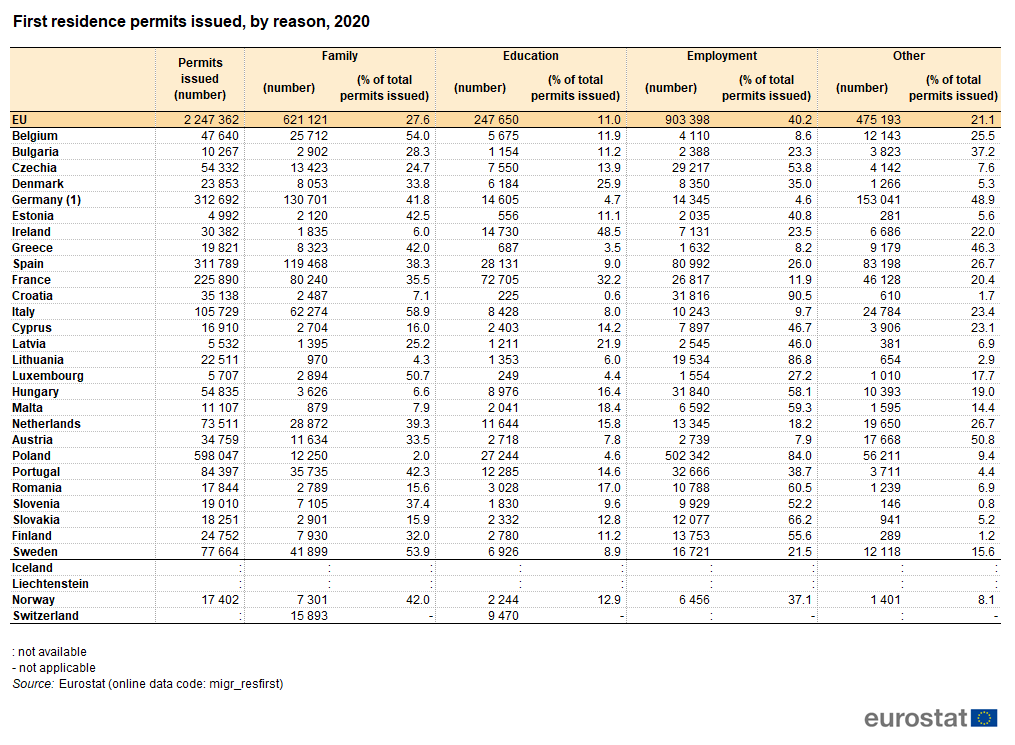
  10. Eurostat (2021), First residence permits issued, by reason, 2020, https://ec.europa.eu/eurostat/statistics-explained/images/f/fb/First_residence_permits_issued%2C_by_reason%2C_2020_T1.png (dostęp 10.07.2022). [Google Scholar]
  11. Frontex (2022), Q1 illegal border crossings into EU highest since 2016, https://frontex.europa.eu/media-centre/news/news-release/q1-illegal-border-crossings-into-eu-highest-since-2016-vvVOak (dostęp 5.07.2022). [Google Scholar]
  12. GUS (2018), Cudzoziemcy na krajowym rynku pracy w ujęciu regionalnym, Warszawa. [Google Scholar]
  13. GUS (2020), Populacja cudzoziemców w Polsce w czasie COVID-19, Warszawa. [Google Scholar]
  14. Lee Everett S. (1966), A theory of migration, „Demography”, nr 3. [Google Scholar]
  15. Ministerstwo Rozwoju Pracy i Technologii (2022), Informacja o zatrudnieniu cudzoziemców w Polsce, https://psz.praca.gov.pl/web/urzad-pracy/-/8180234-informacje-o-zatrudnieniucudzoziemcow-w-polsce (dostęp 17.06.2022). [Google Scholar]
  16. Polska Times (2022), Jarosław Kaczyński: Żadnych relokacji i nie chodzimy po prośbie, https://polskatimes.pl/jaroslaw-kaczynski-zadnych-relokacji-i-nie-chodzimy-po-prosbie-pelnywywiad-z-wicepremierem/ar/c1-16119079 (dostęp 15.06.2022). [Google Scholar]
  17. Straż Graniczna (2021, 2022), Informacje publikowane regularnie na oficjalnym profilu na komunikatorze Twitter, https://twitter.com/Straz_Graniczna (dostęp 10.07.2022). [Google Scholar]
  18. Urząd ds. Cudzoziemców (2022), https://udsc.prowly.com/releases/statystyki-migracyjne (dostęp 15.05.2022). [Google Scholar]
  19. Urząd ds. Cudzoziemców (2021), O status uchodźcy w Polsce nadal najczęściej ubiegają się Białorusini, https://udsc.prowly.com/148844-o-status-uchodzcy-w-polsce-nadal-najczesciej-ubiegajasie-bialorusini (dostęp 5.07.2022). [Google Scholar]
  20. Wojdat Marcin, Cywiński Paweł (2022), Miejska gościnność: wielki wzrost, wyzwania i szanse – Raport o uchodźcach z Ukrainy w największych polskich miastach, Unia Metropolii Polskich, https://metropolie.pl/artykul/miejska-goscinnosc-wielki-wzrost-wyzwania-i-szanse-raporto-uchodzcach-z-ukrainy-w-najwiekszych-polskich-miastach (dostęp 25.06.2022). [Google Scholar]

Downloads

Download data is not yet available.